


How to Stop Saying Um and Other Filler Words: 7 Habits That Work
By the Inverse.AI team · Updated November 2026
Filler words such as um, uh and like plug the gap while your brain plans the next words. See more common filler words and examples. An occasional um is normal in spoken English: it tells listeners you aren't done. Aim for fewer.
In five small public speaking studies, people who learned to notice each filler cut their filled pauses. Seven habits show how to reduce filler words.
- Record yourself and count every filler on playback.
- Ask a friend to flag each filler live.
- Replace each filler with a short silent pause.
- Slow down your speaking rate to plan ahead.
- Breathe between phrases instead of filling the gap.
- Rehearse out loud and script your transitions early.
- Practice impromptu speaking daily on one random topic.
Later sections cover when each habit fits, saying like, presenting, a weekly plan, and calls and recordings.
1. Record Yourself and Count Every Filler
Record 2 to 3 minutes of yourself speaking, play it back, and count each filler; the count shows which filler you lean on most.
Researchers call this step awareness training. In three small studies in the Journal of Applied Behavior Analysis, published from 2016 to 2019, training built on noticing each filler reduced fillers for all participants. One of them, Mancuso and Miltenberger 2016 with 6 students, also added a replacement habit.
In TIME, linguist Valerie Fridland suggests recording a long, casual video chat and reading its transcript. A relaxed call tends to show your everyday fillers.
Each of these recordings fits into a normal week.
- Phone voice memo: answer one practice question for 2 minutes on your phone, then play it back and tick each filler on paper.
- Video call transcript: record a long, casual video chat and read its auto-generated transcript, which shows many of the fillers you use at low stakes.
- Real meeting or class: record a session you already speak in, with permission, so the count reflects how you talk under everyday pressure.
Write the count per filler on a tally sheet and keep it for the practice tracker later. Then divide your total by the words you spoke and multiply by 100. A transcript gives you the word count, or you can count the words in 30 seconds and multiply. That rate lets you compare talks of any length.
| Filler | Count (example) |
|---|---|
| um | IIII IIII I (9) |
| uh | IIII (4) |
| like | IIII III (7) |
| so | III (3) |
| you know | II (2) |
2. Ask a Friend to Flag Your Fillers
Ask a friend or coworker to raise a hand or tap the table each time you say a filler, so you notice it in the moment.
Heather Hayes of Pace University suggests a simple start: ask a close friend whether you use any vocal fillers at all. Harvard Extension School adds a coworker or family member. Toastmasters International clubs build the idea into their meetings. Each club assigns an Ah-Counter, who notes every speaker's filler words and reports the totals at the end.
Pick whichever signal suits your nerves.
- Raised hand: your friend lifts a hand or one finger the moment a filler lands, so you hear it.
- Table tap: a soft tap on the table marks each filler without stopping you or drawing much attention.
- End-of-talk count: the listener keeps a tally and reports it when you finish, the way an Ah-Counter does.
Live signals rattle some speakers, and an end-of-talk count is gentler. In a 2017 study by Spieler and Miltenberger, every student needed booster sessions of awareness training to cut fillers further. Repeat it across several practice talks.
3. Replace Each Filler With a Silent Pause
When you feel an um coming, close your mouth and pause in silence for a moment, then say the next real word.
Linguists call um a filled pause and plain silence a silent pause. Psychologists Herbert Clark and Jean Fox Tree argue that um and uh work like real words that hold your turn in a conversation. That turn-holding job explains the urge to fill every gap.
Psychologists call the method habit reversal: you notice the habit, then swap in a competing response, a new action that blocks the old one. In Pawlik and Perrin 2020, all 4 participants cut disfluencies with a silent pause as the competing response. In Perrin and colleagues 2021, 9 university students in 3 groups cut disfluencies meaningfully, and the drop held at follow-up in front of a small audience.
Harvard Extension School sums the habit up as "Pause, think, answer." It names two hot spots for fillers: the start of an answer and the gap between ideas. Put your pauses there first.
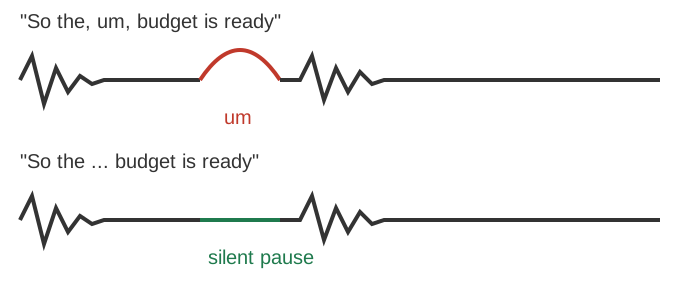
The pause stays; the sound goes.
A three-step drill helps you practice the pause.
- Say the word "pause" out loud each time you catch a filler during a practice talk, then carry on.
- After a few sessions, switch to thinking the word "pause" silently while you keep your mouth closed.
- Drop the cue entirely and let the silence stand on its own until the next real word arrives.
4. Slow Down Your Speaking Rate
Speak a little slower than feels natural, because fast speech leaves your brain behind your mouth and the gap fills with um. Heather Hayes of Pace University told TIME that fillers spill out while the brain catches up, and that slowing down removes the need to fill the silence.
Hard topics need more planning. Bortfeld and colleagues found more disfluency when speakers directed a task or described abstract figures. Slowing your speaking rate, as Hayes suggests, buys planning time on those hard topics.
Three cues keep the pace in check.
- Periods: finish each sentence completely and let it land before you start the next one out loud.
- Hard words: slow down on numbers, names and new terms, where your brain does the most planning.
- Note marks: draw a small slash in your notes at each point where you want to slow down.
5. Use Breathing Instead of Fillers
Close your lips at the end of a phrase, breathe in through your nose, and open your mouth only when the next real word is ready. Vocal coach Roger Love teaches this method to his clients, TIME reported in February 2026.
The method runs in four steps.
- Finish the phrase: complete the thought up to the next comma or period.
- Close your lips: seal them gently the moment the phrase ends, before any sound slips out.
- Inhale through the nose: take one quiet breath while your lips stay closed.
- Start the next phrase: open your mouth only when a real word is ready.
Nose breathing with closed lips gives you the silent pause from habit 3 for free. The breath fills the gap without a sound. Nervous speakers can take one slow breath before the first sentence.
6. Say It Out Loud and Prepare Your Transitions
Fillers cluster where you have not planned the words, so say your talk out loud at least once and script the sentence that moves you from one point to the next. Valerie Fridland made this point in TIME: people think through what they will say but don't talk it through. Rehearsal out loud shows you where the words run out.
The gap between ideas, the second hot spot from habit 3, is where scripted transitions help most. Bortfeld's research ties disfluency to planning load, and a prepared bridge should lighten that load, since you aren't inventing words at the hardest moment.
Adapt any of these eight bridges to your own talk.
- "That leads to the second problem we found."
- "Here is what this means for your budget."
- "Now look at the numbers behind it."
- "The next step builds on that idea."
- "We've covered the cost; now the timeline."
- "One example shows how this works."
- "That leaves one last point to cover today."
- "To pull this together, here is the takeaway."
Build the talk on an outline of 3 to 5 key points, not a memorized script. A script you lose halfway sends you reaching for um.
7. Practice Impromptu Speaking Every Day
Pick a random topic, talk about it for one to two minutes, and count your fillers; unplanned talk is where fillers show up often.
Toastmasters International trains impromptu speaking through Table Topics, a short unplanned speech on a topic you hear on the spot. Toastmasters magazine also describes the Tell-Me Game. A practice partner reads from 20 sealed topics, opened one at a time, and counts your fillers while your answers grow from two minutes to five.
Twenty everyday topics cover nearly three weeks of daily talks, and you can repeat any of them.
- A meal you would cook for guests
- The last book you could not finish
- Your favorite place to walk
- A skill you learned from a video
- The best advice a teacher gave you
- Your ideal weekend with no plans
- A small change that improved your mornings
- The app you open most each day
- A trip that went wrong
- Your first job and its lesson
- A movie you would watch again
- The neighborhood where you grew up
- A gadget you use every day
- How you would spend a free afternoon
- A tradition your family keeps
- The hardest part of your work week
- A city you want to visit next
- A rule you would change at work
- Your favorite season of the year
- A gift you still remember
Record each talk for the tracker below, and raise the length only when your count drops.
How Do You Stop Using Filler Words When Speaking?
Use the 7 habits at three moments: prepare before you speak, pause and breathe while you speak, and review the recording after you speak. Most habits work at more than one moment, so the table maps how to get rid of filler words before, during and after the talk.
| Habit | Before the talk | During the talk | After the talk |
|---|---|---|---|
| 1. Record yourself | Set up your phone to record | not used | Count each filler on the recording |
| 2. Ask a friend | Agree on a signal with your listener | Listener flags each filler as it lands | Ask for the final count |
| 3. Silent pause | Run the three-step pause drill | Close your mouth and pause instead | Note where pauses felt hardest |
| 4. Slow down | Mark slow-down points in your notes | Slow down on numbers and names | not used |
| 5. Breathing | Take one slow breath before starting | Inhale through your nose at commas | not used |
| 6. Out loud and transitions | Rehearse aloud and script each transition | Use your scripted bridge between ideas | Rewrite transitions that still drew fillers |
| 7. Impromptu practice | Talk on one random topic daily | not used | Log the count in your tracker |
Keep the habits switched on in meetings, presentations and interviews, where you most want to sound prepared. With friends, filler words in speech can stay, so relax the habits there. These habits reduce fillers, but the target is fewer, not none.
How Do You Stop Saying Like?
Count your likes in a recording, then replace each filler like with a short pause or with the precise word you meant, such as about, said or for example. Like is one of the word fillers, real words you judge by meaning. Keep it for a comparison ("sounds like rain"), an approximation or a quotative like, and cut it when it only fills a gap.
In Spieler and Miltenberger 2017, awareness training reduced inappropriate use of like for all 4 students. Montes and colleagues found that training cut untargeted fillers for some people only, so track like as its own number.
These four swaps handle the likes that only fill a gap.
- Drop it: "The report was, like, really late" to "The report was really late."
- Pause instead: "I think, like, we should wait" to "I think ... we should wait."
- Use the precise word: "The plan is, like, done" to "The plan is mostly done."
- Give an example: "We could, like, change the deadline" to "We could, for example, change the deadline."
An approximation ("like an hour") or a quotative like ("she was like, no way") is not a filler. Swapping in "about" or "she said" is an optional style edit. For practice, run habit 7 for one week and count like as your only filler. The best word instead of a filler like is usually none, because the pause does the job.
How Do You Stop Saying Um When Presenting?
Prepare an outline, script your opening line and transitions, and take one breath before the first word; in a presentation, the two hot spots from habit 3 are your opening and each change of slides.
Work through these moves before your next talk.
- Outline in chunks: build your presentation on 3 to 5 key points instead of a full script, so a lost line never leaves you stranded.
- Scripted opening line: write and rehearse your first sentence word for word so the talk starts with content instead of an um.
- Transition in the speaker notes: add one bridge sentence to each slide's speaker notes so the move between slides has words ready.
- Breath before each slide: click to the next slide, take one breath with closed lips, then speak the first word of the new point.
- Full run-through: deliver the whole presentation out loud to one listener who counts your fillers like a Toastmasters Ah-Counter, then fix the clusters.
Nerves speed you up, so go back to habit 4 when you notice the rush. In a job interview, apply Harvard Extension School's "Pause, think, answer" before each reply, since the start of an answer is a hot spot.
How Can You Practice Not Saying Um?
Try five minutes a day for four weeks: record a short talk, count your fillers per 100 words, and log the number so you can see it fall. For scale, Kirjavainen and colleagues (2022) put all disfluencies, filled pauses plus repeats and restarts, at roughly 2 to 6 per 100 words in spontaneous speech. A filler-only count will usually run lower.
Every student in Spieler and Miltenberger 2017 needed booster sessions for further gains, and in Perrin and colleagues 2021 the drop held at follow-up. Treat daily practice as steady repetition. Each session holds about 2 minutes of talk plus the count, so fill in one row of the practice tracker afterward.
| Day | Minutes spoken | Words (approx.) | Fillers counted | Fillers per 100 words | Main filler |
|---|---|---|---|---|---|
| 1 (example) | 2 | 260 | 12 | 4.6 | um |
| 2 (example) | 2 | 250 | 11 | 4.4 | um |
| 3 (example) | 2 | 270 | 11 | 4.1 | like |
| 4 (example) | 2 | 260 | 10 | 3.8 | um |
| 5 (example) | 2 | 255 | 9 | 3.5 | like |
| 6 (example) | 2 | 265 | 9 | 3.4 | so |
| 7 (example) | 2 | 260 | 8 | 3.1 | um |
Count, don't judge. When the per-100 number stops falling, add habit 2 and bring in a listener.
How Do You Stop Saying Um Online?
On video calls, webinars and recorded videos, use the same habits plus two online extras: keep your outline on screen, and review the call's auto-generated transcript afterward. A filler you miss live still shows up in the transcript, and in a recorded video or a podcast you can cut it later.
Check Fridland's auto-generated transcript against the audio, since it may not show every um. Fridland also notes that um and uh tell listeners you are not finished. That signal matters on calls where people talk over each other.
Three online habits lower the count on calls.
- Outline beside the camera: put your key points next to the lens, so you can glance at your next point without looking away.
- Breathe after unmuting: unmute, take one breath with closed lips, and start with a real word instead of an um.
- Transcript after the call: open the auto-generated transcript, find each filler you missed live, and add it to your tally sheet.
Can Software Clean Up the Ums You Already Recorded?
Yes, software can cut hesitation sounds such as um, uh, er and hmm from a finished audio recording. Word fillers such as like stay for you to cut by hand.
Already recorded? Clean the ums after
Noise Reducer's filler word remover cuts um, uh, er, erm and hmm, and keeps your words, breaths and natural pauses. It listens for the sound of a hesitation instead of reading words, so it needs no transcript, and its cut list lets you move, delete or add any cut. Upload an audio file or a video to clean the ums out of a recording; from a video, only the sound is uploaded.
Which Filler Words Can You Cut After Recording?
The fillers you can cut after recording split into hesitation sounds, which software finds on its own, and word fillers, which you cut by hand. The split decides how much work an edit takes.
| Filler | Cut automatically? | How to handle it |
|---|---|---|
| um, uh, er, hmm | Yes | A sound-based tool finds and cuts them |
| like, so, you know | No | Add a manual cut where the word is a filler |
| Silent pauses and breaths | Kept on purpose | Leave them in; they keep speech natural |
Word fillers stay in the file because the same words do real work in other sentences.
What Can You Replace Um With?
The best replacement for um is nothing: a silent pause while live, and a short joined gap in an edited recording. Use one of the first three; the last item is the swap to skip.
- Silent pause: two studies used it as the replacement habit, and disfluencies dropped.
- A breath: inhale through your nose with closed lips until the next word is ready.
- A scripted transition: a prepared bridge sentence fills the gap between two ideas.
- Not another filler: swapping um for so or like only moves the problem.
In an edit, Noise Reducer joins each cut with a short crossfade.